The History of AI
Artificial intelligence (AI) is a central factor in modern technology. As a field of computer science where machines emulate human intelligence, AI has evolved from philosophical concepts, developing through mathematical and engineering principles over centuries. At a time when generative AI and deep learning are significantly transforming our daily lives, understanding AI’s trajectory is crucial for responsibly guiding its future.
Introduction to AI and Why Its History Matters
Artificial intelligence (AI) is simply the development of computer systems to perform tasks similar to those of human intelligence. These computer systems are capable of performing functions like learning, problem-solving, decision-making, and language comprehension.
Understanding the historical background of AI is vital for accurately assessing its current capabilities and limitations. Furthermore, knowledge of the failures and resurgences in AI development (AI winters) provides a solid foundation for managing future exaggerated expectations and preparing for ethical challenges.
The Earliest Foundations of AI – From the Ancient Age to 1950
The idea of AI even appears in ancient Greek mythology, which included the concept of automatons created to assist humans. However, the philosophical discussion of whether a machine could possess the ability to think or have critical intelligence first arose in the 17th century. The idea of mind-body dualism by the French philosopher Rene Descartes created the necessary theoretical background for posing the question of whether the human mind could be imitated by mechanical processes. By the 1940s, mathematical and logical discoveries, such as Alan Turing’s “Turing machine”, were establishing the theoretical basis for artificial intelligence.
The Birth of AI – Dartmouth Conference and Turing Test
A decisive figure in the history of AI is the British mathematician, Alan Turing. In his 1950 paper, “Computing Machinery and Intelligence”, he first directed the problem of defining machine intelligence toward a logical experiment. This test, known as the Turing test, provided the criteria needed to determine how successfully a machine could imitate a human’s conversational abilities.
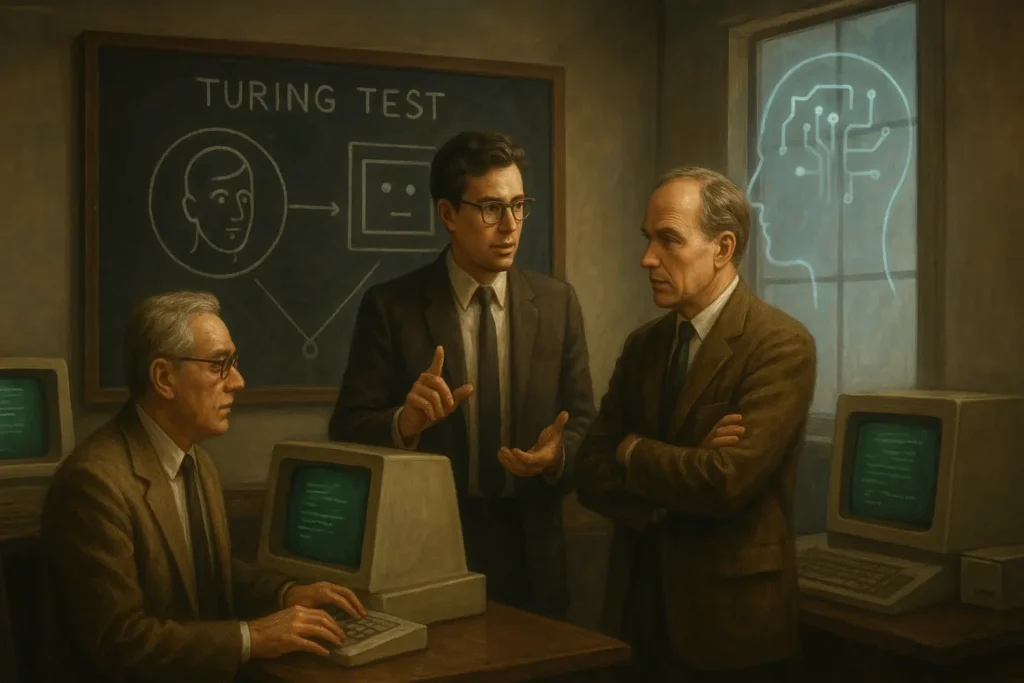
However, the term “artificial intelligence” was first coined in 1956. The Dartmouth Conference, held at Dartmouth College in New Hampshire, was attended by ten scientists. There, John McCarthy officially named this new technical discipline “artificial intelligence”. The conference thus marked the beginning of a new era for AI research.
The Early Phase of AI and First AI Winter
AI research accelerated during the late 1950s and early 1960s. The “logic theorist”, created by Allen Newell and Herbert Simon, was one of the world’s first computer AI programs, demonstrating that a computer could automatically arrive at conclusions via logical rules. In this case, when given a few basic logical rules (for example, if A is true, then B is true; if B is true, then C is true), the logic theorist program successfully used those rules to logically arrive at a new true conclusion (i.e., if A is true, then C must also be true).
Furthermore, by the mid-1960s, the ELIZA chatbot, created by Joseph Weizenbaum, demonstrated the ability to respond by imitating simple human conversational patterns. Despite these developments, the AI field faced a crisis in the 1970s, which is known as the first AI winter.
The crisis was mainly caused by,
- Exaggerated expectations – AI researchers in the 1950s and 1960s made promises and raised hopes far beyond their actual technical capabilities.
- Technical limitations – The weaknesses of computer hardware and the limits of data storage capacity prevented the solution of complex problems.
Under these crisis conditions, the researchers’ failure to deliver on the exaggerated promises (expectations) within the stipulated time led to funding cuts from government agencies. The limitations in computational power also slowed the progress of AI research.
The Rise of Expert Systems and Second AI Winter
In the early 1980s, the AI field experienced a revival with the introduction of expert systems. These systems were designed to emulate the decision-making abilities of a human expert within a specific knowledge domain by encoding the expert’s knowledge and decision rules.
Expert systems such as MYCIN (for medical diagnosis), DENDRAL (for analysing molecular structures), and XCON (for computer configuration) showed notable results in the fields of medicine, engineering, and finance. However, due to the practical difficulties and extremely high costs of updating the knowledge in these systems and scaling up their operation, their popularity declined by the late 1980s. This period is considered the second AI winter.
The AI Resurgence – Machine Learning and Deep Blue
Following the second AI winter, the AI field began to resurface in the 1990s. This was primarily due to the expansion of computer hardware capabilities (especially processing speed) and the rapid proliferation of the internet, which provided access to vast amounts of big data. This volume of big data allowed AI algorithms to identify complex patterns and train with greater accuracy, which led to an increased focus on machine learning and artificial neural networks.
A central event in this resurgence was the defeat of the then-world chess champion, Garry Kasparov, by IBM’s Deep Blue supercomputer in 1997. This was a historic moment that demonstrated to the world that a machine could surpass a human intellectual capability. The event directly led to increased government and private sector funding for AI research.

AI in the 21st Century – Deep Learning and New Discoveries
The start of the 2000s saw a new revolution centred on deep learning. This method, which utilises multiple layers of neural networks, brought unprecedented progress in fields such as computer vision, natural language processing (NLP), and robotics.
With the improvement in natural language processing (NLP) capabilities, AI has taken a major role in key applications like well-known voice assistant systems such as Apple’s Siri and Amazon’s Alexa, as well as data analysis strategies within Google Search. Google DeepMind’s AlphaGo program further affirmed AI’s power by defeating a world champion in the game of Go in 2016. Furthermore, currently, autonomous vehicles and large language models, such as GPT (generative pre-trained transformer), which can understand human language and generate responses, are marking a new era in the AI field.
Challenges and Ethical Issues in AI
The rapid growth of AI technology is raising serious ethical and social issues. There is strong criticism regarding the use of AI systems in areas that determine human opportunity, such as employment, finance, or justice, due to the risk of biased and unjust decisions. These biased decisions are fundamentally rooted in the social and ethnic biases present in the datasets used to train the AI.
Furthermore, serious ethical questions have arisen regarding the use of AI in high-risk areas, such as mass surveillance that can violate privacy by analysing video footage and online data, and autonomous weapons. In addition, the fear of job displacement due to the use of AI for task automation has now spread across many industries.
The Future of AI and AGI
Analysts strongly believe that the future of artificial intelligence will move beyond the current narrow AI (AI for specific tasks only) toward AGI (artificial general intelligence). AGI is the level at which a system can successfully perform any intellectual task a human can.
Future trends anticipate the introduction of personalised medicine, with treatments based on individual genetic and biological data in the health sector. AI-based automation is also expected to reach new levels in factories and the service sectors.
Alongside this technological progress, global regulations, such as the EU AI Act, are expected to establish clear ethical and legal guidelines for AI development in the near future to control the emerging risks (such as bias and privacy violations).
Conclusion
The history of AI began as an idea rooted in ancient theories and has developed into real-world applications today. Every phase, from the beginning at the Dartmouth Conference to deep learning, demonstrates humanity’s unwavering commitment to innovation. As of December 2025, we are in a critical period where AI’s potential is at its maximum, but we must also confront its challenges. In such a period, responsible development of AI technology within ethical boundaries is essential if this powerful technology is to be used for the benefit of humankind.