
Ray Tracing Technology Overview
In the past, video games and 3d animation brought beautiful visuals to our screens, but the lighting, shadows, and reflections often felt artificial. However, the introduction of ray tracing technology has revolutionized the art of computer graphics. Simply put, ray tracing is a method of creating photorealistic lighting, shadows, and reflections within computer graphics by simulating how light rays travel in the real world. This technology is quickly becoming an essential element, especially in modern video games and the film industry, successfully translating the real-world visual experience into the digital domain.
What is Ray Tracing?
A Simple Explanation of Ray Tracing
Ray tracing is a computer graphics algorithm that accurately simulates the behavior of light in a 3D environment. Unlike traditional graphics methods, the ray tracing process involves the computer casting thousands of rays from a virtual camera, which represents the viewer’s perspective, out into the scene. The computer then calculates how these rays interact with the objects in the scene—by reflecting, refracting, absorbing, or scattering. The result of these complex computations is the creation of visually accurate and realistic light and shadow.
Its Importance in Modern Gaming and Graphics
Ray tracing is critically important in the modern computer graphics landscape because it delivers a more immersive experience for players and viewers. With next-generation GPUs such as NVIDIA RTX and AMD Radeon RX supporting real-time ray tracing as of 2025, it has become possible to instantaneously create highly realistic shadows and reflections. These lifelike graphics significantly enhance the emotional depth and visual quality within a game or 3D creation.
How Real-World Light Works (A Simple Explanation)
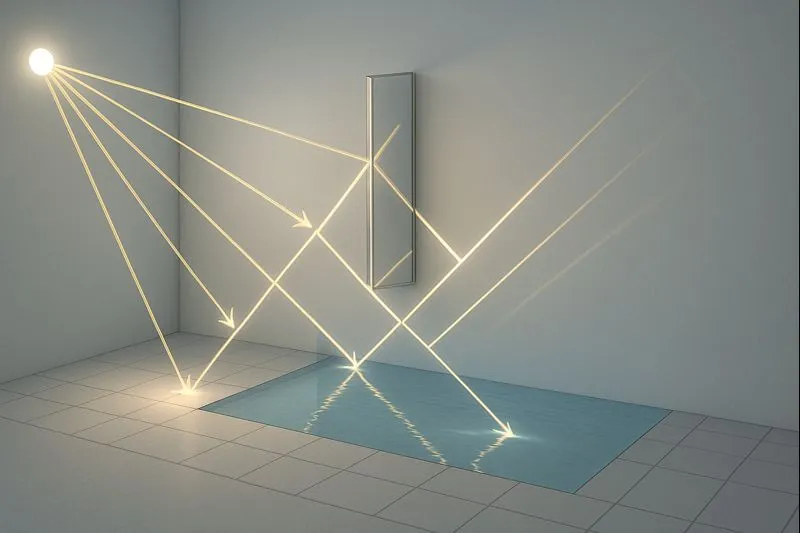
Although light physically travels along straight lines in the real world, its interaction with objects is complex. Rays emitted from a light source (such as the sun) travel linearly, but their behavior changes upon hitting an object.
- reflection – when a ray strikes a polished or shiny surface, it bounces back away from the surface.
- diffusion – when a ray strikes a rough or matte surface, it scatters in all directions.
- shadows – shadows are created when objects block light. Even shadows are not completely dark in the real world; they are softened by indirect light received from the surroundings.
Ray tracing technology attempts to simulate this real-world physical behavior through mathematical formulas. By calculating how the rays, which are sent from the virtual camera (representing the viewer’s viewpoint) and through the pixels on the screen, travel, reflect, and scatter back toward a light source within the scene, the digital scene is made to resemble the real world.
How Traditional Graphics Worked Before Ray Tracing (Rasterization)
The Basic Idea of Rasterization
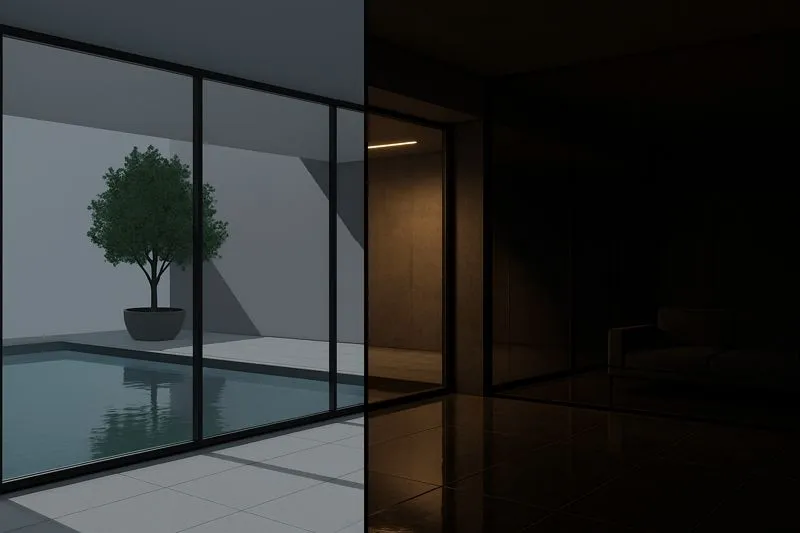
Before the advent of ray tracing, the primary technology in computer graphics was the rasterization method. In this approach, the shapes of 3D objects are represented as triangles for the graphics processing unit (GPU) to process. The GPU transforms these triangles into pixels on the screen, as seen from the virtual camera’s viewpoint. It then colors these pixels using textures and approximate lighting calculations and artificial light models to generate the final digital scene. Because this process is extremely fast, it has been the dominant technology for video games for decades.
Its Limitations (Artificial Reflections, Simple Shadows)
The main limitation of rasterization was that it did not calculate the physically correct behavior of light in the real world (complex effects such as reflection, refraction, and global illumination). Instead, it used “tricks” or “hacks” to create lighting and reflections.
- fake reflections – methods like screen space reflections (SSR) were used to create reflections. Since this only reflects what is currently on the screen, reflections of objects outside the screen are not shown.
- simple shadows – shadows were created using simple methods like shadow maps. These were unable to blur the edges or demonstrate the softness of shadows.
- lack of global illumination – the inability to properly calculate indirect light resulted in scenes that lacked life and depth.
How Ray Tracing Works
The distinctiveness of ray tracing lies in its approach to calculating light. instead of calculating from the light source, like rasterization, it calculates how light travels backward from the virtual camera representing the viewer’s viewpoint.
1. ray emission – first, a ray (or several rays) is cast from every pixel on the screen into the scene.
2. interaction calculation – when that ray hits an object in the scene, the computer casts additional rays to determine its color and light intensity.
3. updated rays
- reflection ray – if the ray hits a shiny surface, it reflects to find the source of that reflection.
- shadow ray – another ray is cast from that hit point toward the light source to check if the path is blocked, which would result in a shadow.
4. color determination – after calculating all these interactions, the final color of that pixel is determined. This complex calculation process results in reflections that are extremely close to reality and shadows that are accurately and softly rendered.
Why does ray tracing reduce FPS?
The ray tracing process casts thousands of rays from every pixel and calculates its reflection, shadow, and refraction, placing a heavy computational load on the GPU. this heavy load reduces the game’s frame rate (FPS).
Key Components of Ray Tracing
- true reflections – surfaces like water or polished metal appear realistic because it can reflect scenes even if they are not on the screen.
- accurate shadows – the softness and sharpness of shadows vary accurately according to the size of the light source (soft shadows).
- global illumination – it correctly simulates how objects absorb and diffuse color, and how that color then falls onto surrounding objects (color bleeding).
Main Types of Ray Tracing
Ray tracing is not a single method applied to all lighting effects but a group of techniques used for various purposes. Typically, modern video games use a combination of several ray tracing methods.
- ray-traced reflections (RTR) – this component creates the most dramatic visual difference. it renders surfaces like glass, water, and polished floors to reflect light as they would in the real world.
- ray-traced shadows (RTS) – accurately calculates the softness of shadow edges. shadows are softer if the light source is larger and sharper if it is smaller.
- ray-traced global illumination (RTGI) – calculates indirect illumination. this accurately simulates how light hits one object and then illuminates another. it adds life and depth to the scene.
- ray-traced ambient occlusion (RTAO) – more accurately calculates the small shadows (ambient occlusion) that occur where two objects or two surfaces meet very closely.
Benefits of Ray Tracing
Ray tracing elevates the quality of digital graphics to a new level. Some of its main benefits are listed below.
- extremely realistic graphics – the realism of the graphics is greatly increased. ray tracing has delivered the visual quality that 3D animated films, in particular, have been attempting to achieve for years.
- natural lighting – the global illumination and indirect light effects from the shadows created by ray tracing make the lighting appear as natural as in the real world. for example, if a room’s wall is red, a white object nearby will also be tinged with red light (color bleeding).
- true reflections – the need for using fake reflections is completely eliminated, allowing for the instantaneous creation of true reflections of all objects in the scene.
- more immersive scenes – the heightened visual authenticity allows the player or viewer to delve deeper into the digital world.
Limitations and Challenges
Despite the significant advancements in ray tracing technology, there are still notable limitations and challenges it must address.
Do i need a special GPU to run ray tracing?
Yes, specialized hardware (hardware accelerated ray tracing) like Nvidia RTX (with RT cores) or AMD Radeon RX 6000 series or higher is required to run ray tracing in real-time. older GPUs can perform ray tracing through software, but the performance will be very slow.
- powerful GPU requirement – ray tracing calculations are highly complex, requiring high-end GPUs with specialized ray tracing cores (RT cores), such as the Nvidia GeForce RTX 4000 series or AMD Radeon RX 7000 series, to perform them in real-time.
- lower fps (frame rate) – when ray tracing is enabled, a large amount of the GPU’s resources is consumed, causing the frame rate (frames per second – FPS) in many games to drop significantly. this can hinder the gaming experience.
- unsupported games – while most major AAA games support ray tracing by 2025, not all older or indie games take advantage of this technology.
- increased power consumption – since ray tracing requires more computational power, the GPU consumes more electricity and also generates more heat.
Ray Tracing in Current Games
Ray tracing has become an integral part of computer graphics. it has become the standard on both new-generation consoles and PCs.
- modern AAA games – AAA (triple-A) games like Cyberpunk 2077, Control, and Alan Wake 2 fully utilize advanced ray tracing features such as ray-traced global illumination and path tracing, resulting in unprecedented visual quality.
- PS5 and Xbox Series X support – both the Sony Playstation 5 and Microsoft Xbox Series X consoles are equipped with ray tracing capabilities. this was fundamental in making ray tracing a mainstream technology within the world of computer gaming.
- new GPUs and upscaling – to overcome the FPS challenge of ray tracing, AI-based upscaling technologies such as Nvidia DLSS (deep learning super sampling) and AMD FSR (FidelityFX Super Resolution) have become essential.
The Future (Real-Time Path Tracing)
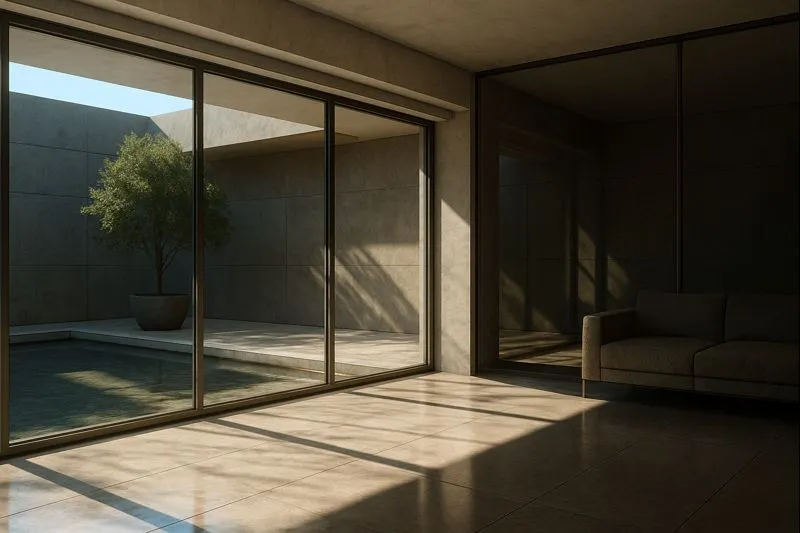
The next step in ray tracing is real-time path tracing.
path tracing is an advanced form of ray tracing. instead of sending one ray per pixel, a large number of rays are cast in various directions. this precisely calculates every indirect light interaction, reflection, and refraction between light sources and objects, just as in the real world.
- complete realism – path tracing makes 3D scenes look like a real photograph. while the capabilities of path tracing are already visible in limited modes, such as the ray tracing – overdrive mode in Cyberpunk 2077, future trends suggest that path tracing will become a mainstream technology, even on mid-range GPUs, by 2026-2027.
Conclusion
Ray tracing is a symbol of progress in the field of computer graphics. it has surpassed the limitations of rasterization and brought the physics of real-world light into the digital environment. while it is heavily dependent on powerful hardware and new upscaling technologies, ray tracing has dramatically elevated the visual authenticity in games and 3D animation. with the arrival of path tracing, this technology will shape the future of computer graphics, further minimizing the visual gap between the digital and real worlds.





One Comment